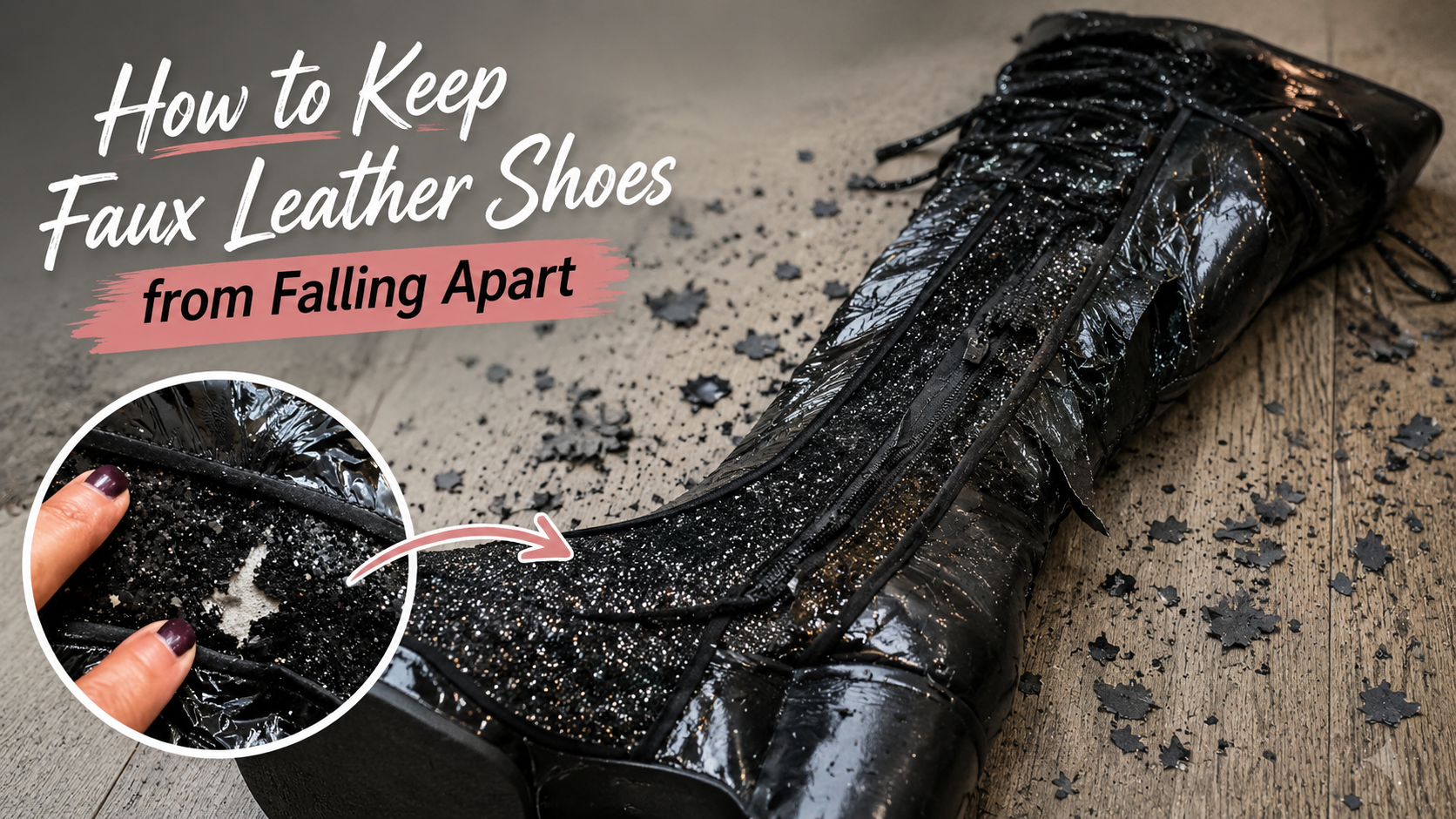
I recently suffered the loss of a favorite pair of faux leather boots. They had not been worn in over 10 years, and when I pulled them out the box, they started to crumble!
They had been stored in their box, in an air-conditioned room. But they still didn’t last. So, I did some research to see if there was anything I could do to make my faux leather shoes last longer.
You can see the sad situation in my video below, where my platform boots are pretty much disintegrating:
Faux leather shoes can look beautiful for years, but as my story shows, putting them in a box and leaving them untouched doesn’t guarantee they will stay in good condition. Over time, faux leather will crack, peel, become sticky, or even begin to crumble.
While this deterioration is often referred to as “dry rot,” faux leather doesn’t actually dry rot in the same way natural materials can. Understanding what’s really happening—and how you store your shoes—can help you keep them looking good for as long as possible.
If you are wondering how to keep your faux leather shoes from falling apart during storage, I have bad news. You can extend their life, but they’re eventually going to fall apart no matter what. Here’s how to get the most life out of your faux leather. (it goes for clothing as well)
Why Does Faux Leather Fall Apart?
Most faux leather is made by applying a synthetic coating, commonly polyurethane (PU) or PVC, over a fabric backing. As the material ages, that synthetic layer can begin to chemically break down.
With PU faux leather in particular, moisture can contribute to a chemical process known as hydrolysis. Heat, humidity, sunlight, and environmental conditions can speed deterioration. Eventually, the surface may start cracking or peeling away from the fabric underneath.

This means faux leather can deteriorate even if you never wear the shoes.
Some shoes have another problem: polyurethane soles. Certain PU soles can deteriorate during long periods of storage and eventually crack or crumble. Adhesives used to construct shoes can also weaken with age.
I can’t count the number of times I’ve had the sole of an old shoe start flopping and separate from the top, usually while I’m wearing them!
Unfortunately, there is no storage method that can guarantee faux leather will last forever. Good storage conditions can, however, help slow down deterioration.
Store Faux Leather Shoes Somewhere Cool
Heat is one of the biggest enemies of long-term shoe storage. A climate-controlled closet inside your home is generally a much better choice than an attic, garage, shed, or other area that experiences high temperatures.
This is especially important in hot and humid climates, like here in Florida.
Avoid placing shoe boxes near heating vents, windows, or other locations where temperatures fluctuate dramatically.
I’ve always kept mine in a nice cool room, and they still fell apart.
Humidity Matters—But Don’t Make the Shoes Extremely Dry
You may have heard that silica gel packets are good for storing shoes. They can be, but the goal isn’t to remove every bit of moisture from the storage environment.
Silica gel is a desiccant, meaning it absorbs moisture from the surrounding air. A small packet can help prevent excessive humidity inside a shoe box.
However, you don’t need to fill the box with silica gel or try to create an extremely dry environment. The goal is stable, moderate humidity rather than “as dry as possible.”
For home storage, approximately 40–55% relative humidity is a reasonable range to aim for.
A small silica gel packet in a shoe box can therefore be useful, particularly if you live somewhere humid. Packing shoes into an airtight container with large quantities of desiccant isn’t necessary and may create an excessively dry environment.
This is actually something I never paid attention to before, but will now!
Don’t Seal Faux Leather Shoes in Plastic Bags
It can be tempting to put valuable shoes into plastic bags before storing them. However, sealed plastic can trap moisture and create an undesirable microclimate around the shoes.
A breathable shoe bag or appropriate storage box is generally a better option.
If you’re using the original shoe box, make sure both the shoes and box are completely dry before putting everything away.
Clean Shoes Before Putting Them into Storage
Dirt, sweat, oils, makeup, and other substances shouldn’t remain on shoes during long-term storage.
Before storing faux leather shoes, gently wipe the surface with a soft, slightly damp cloth. Avoid soaking the material.
Allow the shoes to air dry completely before putting them into their storage container.
Be cautious about using traditional leather conditioners. Products formulated for genuine leather aren’t necessarily appropriate for PU or PVC faux leather. They may leave residue or even damage certain synthetic finishes.
If you want to use a protectant or cleaner, look for something specifically identified as suitable for the type of synthetic material your shoes contain and test it on a hidden area first.
Stuff Shoes to Help Maintain Their Shape
Shoes that sit empty for years can become misshapen, particularly if other objects press against them.
Loosely stuffing the shoes with acid-free tissue paper can help them maintain their original shape without placing excessive pressure on the material.
Avoid tightly packing the shoes. You only need enough tissue to support their shape.
It’s also better to use acid-free tissue rather than newspaper. Newspaper can transfer ink and isn’t designed for archival storage.
Don’t Stack Heavy Items on Faux Leather Shoes
Pressure can create permanent creases in faux leather. As the material ages, those creases may become areas where cracking or peeling begins.
Store shoes so that nothing heavy is pressing against the uppers, straps, decorative pieces, or heels.
This is especially important for costume and cosplay shoes that may have unusual shapes or delicate embellishments.
Check Stored Shoes Occasionally
One of the worst things you can do with collectible shoes is put them into storage and forget about them for 10 years. (oops)
Take them out periodically and inspect them.
Look for changes such as peeling, cracking, stickiness, discoloration, mold, unusual odors, separation around glued areas, or deterioration of the soles.
Periodic inspections also give you an opportunity to make sure the storage area hasn’t developed a moisture or temperature problem.
Never Wearing Shoes Doesn’t Necessarily Preserve Them
This surprises many collectors.
You might assume that a pair of shoes kept unworn in its original box will remain pristine indefinitely. Unfortunately, some materials deteriorate because of age and chemical reactions rather than physical wear.
Polyurethane components, adhesives, foams, and faux leather coatings can all deteriorate while sitting in storage.
That’s why you occasionally see decades-old shoes that appear perfect inside the box but begin cracking or crumbling shortly after they’re handled.
The photo below shows what it looks like, after trying on thigh high boots there were on a shelf for the last 10 years. The stuff all around the boots is actually the faux leather lining inside the boots.
It totally came apart when I tried to put my foot in it, and it got my socks all gross and dirty. These are 13″ platforms, and that’s something you don’t want coming apart while wearing!

Can You Completely Prevent Faux Leather from Peeling?
Unfortunately, no.
Once the synthetic coating begins chemically breaking down, there isn’t a conditioner or treatment that can permanently reverse the process. Products may temporarily improve the appearance of aging faux leather, but they can’t restore deteriorated polyurethane to its original state.
The best approach is prevention.
Keep faux leather shoes somewhere cool, dark, clean, and climate-controlled. Avoid excessive humidity, extreme dryness, high temperatures, direct sunlight, trapped moisture, and unnecessary pressure on the material.
You may not be able to make faux leather last forever, but thoughtful storage can give your favorite shoes the best possible chance of surviving for many more years.

Leave a Reply