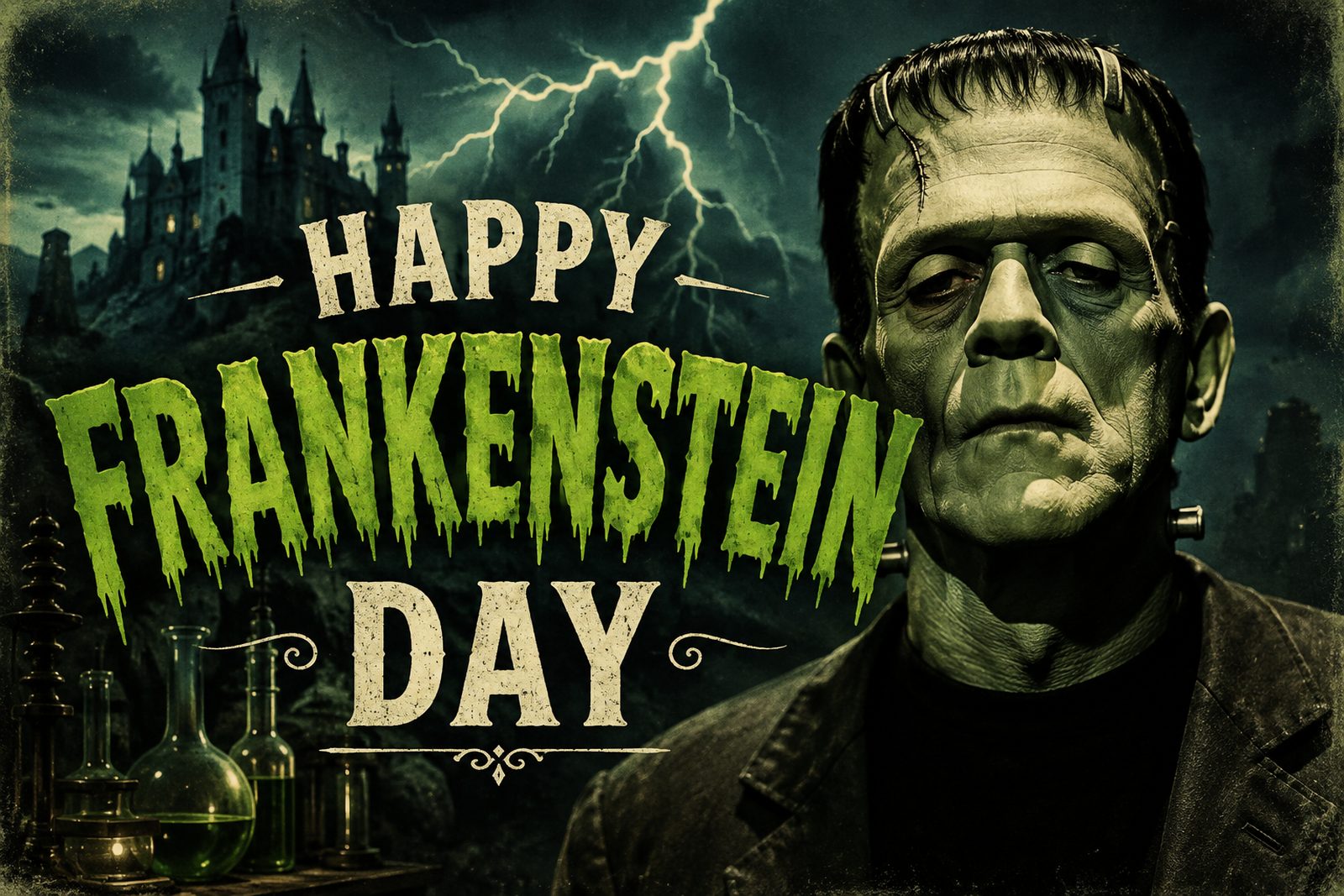
Every year on August 30, horror fans, literature lovers and anyone with an appreciation for classic monsters have an extra reason to celebrate: it’s Frankenstein Day!
While Frankenstein may feel permanently connected to Halloween, Frankenstein Day actually falls two months earlier for a very good reason. August 30 is the birthday of Mary Shelley, the woman who created Victor Frankenstein and his famous creature more than 200 years ago.

What began as a Gothic novel written by a young woman in the early 1800s eventually inspired plays, movies, Halloween costumes, toys and one of the most recognizable monsters in popular culture.
So, how did Frankenstein Day get started, and how did Mary Shelley’s unnamed creature become the green, flat-headed monster most of us picture today?
Prefer to listen? Click here for the Midnight Pumpkin Podcast, Episode 1: Frankenstein
When Is Frankenstein Day?
Frankenstein Day is celebrated annually on August 30, the birthday of author Mary Shelley, who was born in London on August 30, 1797.
The unofficial holiday celebrates Shelley as well as her groundbreaking novel, Frankenstein; or, The Modern Prometheus.
You may also see the holiday called National Frankenstein Day.
There is occasionally some confusion surrounding Frankenstein-themed holidays because other unofficial Frankenstein observances have appeared on calendars over the years.
However, August 30 is the date widely recognized as Frankenstein Day because of its direct connection to Mary Shelley.

The Real History of Frankenstein Starts with Mary Shelley
Mary Shelley was born Mary Wollstonecraft Godwin in London in 1797.
Her parents were both prominent intellectuals. Her mother, Mary Wollstonecraft, wrote A Vindication of the Rights of Woman and became one of history’s best-known early advocates for women’s rights. Her father, William Godwin, was a writer and political philosopher.
Mary would eventually become involved with poet Percy Bysshe Shelley, whom she married in 1816.
That same year, during a stay near Lake Geneva in Switzerland, Mary participated in what would become one of the most famous storytelling challenges in literary history.
Mary and Percy were spending time with Lord Byron and others during an unusually cold and rainy summer. The gloomy weather kept the group indoors, where they read ghost stories and challenged one another to write their own supernatural tales.
Mary initially struggled to think of an idea, and then inspiration arrived in the form of a disturbing vision.
She imagined a scientist who had discovered a way to create life and then recoiled in horror at the living being he had made.
That idea eventually became Frankenstein.
Frankenstein Was Published Anonymously in 1818
The first edition of Frankenstein; or, The Modern Prometheus was published in London on January 1, 1818.
Only 500 copies were printed, and Mary Shelley’s name wasn’t on them. The novel was published anonymously.
Mary was only 20 years old when the book appeared.
Her identity as the author was revealed on the title page of the second edition, published in 1823. She later revised the novel for another edition published in 1831, adding an introduction explaining how she came up with her famous story.
More than two centuries later, Frankenstein remains in print and is considered an enormously influential work of Gothic literature and early science fiction.
Frankenstein Isn’t Actually the Monster’s Name
Here’s the Frankenstein fact that people love to point out: Frankenstein is the name of the scientist, not the monster.
Victor Frankenstein is the young scientist who discovers a way to bring dead matter to life.
His creation is never actually given a proper name in Mary Shelley’s novel. Shelley refers to him in various ways, including as a creature, monster and other descriptions.
Over time, however, popular culture began calling the creature “Frankenstein” as well. The association became so strong that Frankenstein is now commonly understood to mean both the creator and his creation depending on the context.
So if you call the monster Frankenstein, everyone knows exactly who you mean — even if a literary purist may feel compelled to correct you.
The Original Frankenstein Monster Didn’t Look Like the One We Know Today
If someone says “Frankenstein,” you can probably picture him immediately.
Greenish skin. Flat head. Heavy brow. Stitches. Bolts sticking out of his neck. Big boots and an awkward walk.
But Mary Shelley didn’t create that version of the monster.
The familiar Frankenstein appearance owes much more to Hollywood, particularly Universal Pictures’ 1931 film Frankenstein.
The movie starred Boris Karloff as the Monster and was directed by James Whale. Makeup artist Jack Pierce was largely responsible for transforming Karloff into the character who would become instantly recognizable around the world.

Pierce’s makeup gave the Monster his distinctive flattened head, heavy features, scars and electrodes at his neck. Karloff’s costume and enormous boots further changed his silhouette and contributed to his lumbering appearance.
The transformation wasn’t easy for Karloff. The makeup process took hours, and the heavy costume and boots made playing the Monster physically demanding.
The result was worth it, as Karloff’s Frankenstein Monster became one of the defining images of 20th-century horror.

Frankenstein Wasn’t Originally Green Either
In the novel, Mary Shelley describes Frankestein’s skin as having a yellowish appearance.
The famous green Frankenstein is another product of later popular culture.
Interestingly, Jack Pierce used gray-green greasepaint on Boris Karloff for the 1931 movie. Although audiences were watching a black-and-white film, the makeup color helped create the pale, corpse-like appearance Pierce wanted on camera.
Over the decades, merchandise, cartoons, Halloween decorations and color illustrations helped cement green as Frankenstein’s signature color.
The 1931 Movie Changed Frankenstein Forever
Mary Shelley’s novel was already more than a century old when Universal released Frankenstein in 1931.
The movie changed the way generations would imagine the character.
It also changed parts of the story.
One famous example involves the Monster’s brain. In the Universal film, an assistant accidentally provides Frankenstein with a criminal or “abnormal” brain, helping explain the Monster’s violent behavior.
But in the original story, Shelley’s creature is considerably more intelligent and articulate. He learns language, reads and reflects on his own existence. Much of his anger develops after repeated rejection and isolation.
That makes the original story much more complicated than a simple tale about a mad scientist creating a murderous monster.
It’s also part of the reason Frankenstein has remained relevant for more than 200 years.
Then Came the Bride of Frankenstein
Universal followed its successful movie with Bride of Frankenstein in 1935.
Boris Karloff returned as the Monster, while Elsa Lanchester memorably appeared as both Mary Shelley and the Monster’s intended bride.
The Bride’s towering hair with its white lightning-like streaks became nearly as iconic as Frankenstein’s flat head and neck bolts.
I did my own Bride of Frankenstein look one Halloween, neck bolts and all!

Interestingly, the idea of creating a female companion does come from Shelley’s novel, although the famous Bride we know from the movie is very different from what happens in the book.
The Bride has relatively little screen time, yet she became one of the most recognizable female monsters in horror history.
Why Frankenstein Was Such a Revolutionary Story
Frankenstein works as a horror story, but there’s much more happening beneath the surface.
The novel explores questions that still feel surprisingly modern:
What happens when science advances faster than our ability to understand its consequences?
Does a creator have a responsibility to what they create?
Is someone born monstrous, or can rejection and cruelty turn them into a monster?
How far should humans go in trying to control life and death?
Those questions are part of the reason Frankenstein is frequently described as an early or foundational work of science fiction.
Mary Shelley wasn’t simply writing about something supernatural appearing from nowhere. Victor uses experimentation and scientific knowledge to accomplish something that shouldn’t be possible.
The science may be fictional, but the concept feels remarkably familiar in a world where we regularly debate artificial intelligence, genetic engineering, cloning and other rapidly developing technologies.
More Than 200 Years of Frankenstein
The most remarkable thing about Frankenstein Day may be just how long the character being celebrated has survived.
The novel was published in 1818.
The famous Universal movie arrived in 1931.
And Frankenstein is still everywhere.
He’s in movies, television shows, cartoons, comic books, Halloween decorations, breakfast cereal, toys, video games and countless costumes.
He’s scary enough to remain a horror icon but familiar enough to appear on children’s Halloween decorations.
Few fictional characters created in the early 19th century are still instantly recognizable to people who have never even read the original book.
Frankenstein managed to make that leap.
How to Celebrate Frankenstein Day
If you want to celebrate Frankenstein Day on August 30, there are plenty of options.
You can read Mary Shelley’s original novel, watch the 1931 Frankenstein, follow it with Bride of Frankenstein, visit a classic horror exhibit, make Frankenstein-themed food or simply break out your favorite monster costume.
Click here to get Frankenstein on Amazon! (affiliate link)
It’s also a great day to share Frankenstein cosplay or old Halloween costume photos. (which is what I’m doing, of course)

And if August 30 slips by unnoticed, there’s really no reason the celebration has to end at midnight. Frankenstein is one monster who is particularly good at coming back from the dead. bwahahahaha….
Frankenstein Day Celebrates More Than a Monster
Frankenstein Day may be a fun excuse to celebrate one of horror’s most famous characters, but August 30 is ultimately a celebration of Mary Shelley.
A story conceived by a teenage writer during a rainy summer in 1816 became a novel in 1818 and eventually transformed into an international cultural phenomenon.
The Frankenstein most people recognize today is a combination of Shelley’s original creation and nearly two centuries of theater, movies, makeup, artwork and popular culture.
The details have changed considerably along the way.
But the basic idea that Mary Shelley dreamed up more than 200 years ago — a human being creating life and discovering he cannot control what he has made — has never really stopped being fascinating.
And that’s a pretty impressive reason to give Frankenstein his own day.

Leave a Reply